
Showing posts with label Dodge. Show all posts

2008 Dodge Viper SRT10 ACR

There are two places on the long track at Willow Springs International Raceway where you can clearly feel the difference between the 2008 Dodge Viper SRT10 ACR and any other Viper.One is at the turn-in point of Turn 8, a fast right-hand sweeper that is entered at a very high speed, where a decent front-to-rear handling balance is necessary to swing the nose to the apex without losing the tail. The other is at the exit of Turn 2, where you come off the corner hard on the power to squirt down the short chute to Turn 3's tricky uphill left-hander.
In both of these places, the 2008 Dodge Viper SRT10 ACR feels noticeably better pinned to the asphalt than not only the current Viper SRT10 but also any other Viper we've ever driven.We're grateful. We can remember hammering that first 1992 Viper roadster down into Turn 8 at 120 mph all those years ago and it felt like an airplane crash in the making, as if it was going to take off and smash itself to pieces in the desert.

Specifications:


price $79,625 USD
engine V10
valvetrain OHV 2 Valves / Cyl
displacement 7990 cc / 487.6 cu in
bore 101.6 mm / 4.0 in
stroke 98.5 mm / 3.88 in
compression 9.6:1
power Not Available kw / 460 bhp @ 5200 rpm
bhp/weight
torque 677.9 nm / 500.0 ft lbs @ 3700 rpm
redline 6000 rpm
drive wheels Front Engine / RWD
body / frame Molded Composite
front brakes Vented Discs w/Vacuum Assist
f brake size 330 mm / 13.0 in
rear brakes Vented Discs w/Vacuum Assist
r brake size 330 mm / 13.0 in
front wheels F 45.7 x 50.8 cm / 18.0 x 20.0 in
rear wheels R 45.7 x 66.0 cm / 18.0 x 26.0 in
front tire size F 275/35ZR-18
rear tire size R 335/30ZR-18
steering Rack & Pinion w/ Power Assist
weight 1522 kg / 3355 lbs
wheelbase 2443 mm / 96.2 in
front track 1514 mm / 59.6 in
rear track 1539 mm / 60.6 in
length 4488 mm / 176.7 in
width 1466 mm / 57.7 in
height 1194 mm / 47.0 in
transmission 6-Speed Manual
gear ratios 2.66:1, 1.78:1, 1.30:1, 1.00:1, 0.74:1, 0.50:1
final drive 3.07:1
top speed 273.6 kph / 170.0 mph
0 - 60 mph 4.2 seconds
0 - 100 mph 10.0 seconds
0 - 1/4 mile 12.7 seconds
epa city/hwy 11 / 20 mpg

Dodge Viper Fourth generation ZB (2008–present)

For 2008, the Viper received a 90 hp (67 kW) bump up to 600 hp (450 kW), a 25 lb·ft (34 N·m) torque bump up to 560 lb·ft (759 N·m) and the engine displacement increased up to 8.4 liters (512 ci/8354 cc) from 8.3, also receiving better flowing heads with larger valves, Mechadyne variable valve timing on the exhaust cam lobes, and dual electronic throttle bodies. The rev limit was able to be increased by 300 rpm due to the improved valve-train stability from both the new camshaft profiles and valve-springs. The development of the engine was done with some external assistance from McLaren Automotive and Ricardo Consulting Engineers.Changes outside of the engine were less extreme, but still influential. The Tremec T56 transmission has been replaced with a new Tremec TR6060 which now has triple first gear synchronizers and doubles for higher gears. Shifts are claimed to be 18% quicker than the 2007 Chevrolet Corvette Z06. The Dana M44-4 rear axle from the 2003-2006 model now has a GKN ViscoLok speed-sensing limited-slip differential that greatly helps the tires in getting grip under acceleration. Another performance upgrade was the removal of run-flat tires; the new Michelin Pilot Sport 2 tires have increased driver feedback as well as grip and, along with revised suspension (springs, anti-roll bars, and shock valving), has made the Viper more neutral in cornering.The modifications made to the 2008 model year car were enough for Chrysler to make it distinct from the first SRT-10, and the 2008 model became known as Gen IV, just in time for release with Chevrolet's 620 hp (460 kW) Corvette. Another notable change is the reworking of the exhaust system, previous third generation Vipers had their exhaust crossover under the seats which resulted in a large amount of heat going into the cockpit, this was done initially to help improve the cars exhaust note, since the first 2 generations of Viper, which had no crossover, were criticized for their lackluster exhaust notes. For 2008, the Viper exhaust will utilize a new exhaust system with no crossover, reducing the heat that enters the cockpit, but allowing the Viper to still produce an exotic sound.The electrical system has been completely revised for 2008. Changes include a 180-amp alternator, twin electric cooling fans, electronic throttles, and completely new VENOM engine management system. CAN bus architecture has been intertwined with pre-existing systems to allow for regulatory compliance. The fuel system was upgraded to include a higher capacity fuel pump and filtration system.[3] Car and Driver recently tested the car and got a 0-60 mph time of 3.5 seconds, a 0-100 mph time of 7.6 seconds and a Quarter Mile-time of 11.6 seconds at 126 mph (203 km/h).[4] Dodge's claims for top speed are 197 mph (317 km/h) and 202 mph (325 km/h), for the Roadster and Coupe respectively. Car and Driver also tested the Viper's track performance, and managed a fast sub 3 minute lap time around Virginia International Raceway. The Viper's time, despite hot weather, was faster than the Corvette Z06, Ford GT, Porsche 911 Turbo and 911 GT3, Audi R8, and other such cars. According to Car and Driver and Motortrend, the car's slightly adjusted suspension setup and new differential gave it cornering ability as sharp as before with even better control, feedback, and response.

Dodge Viper Third generation ZB (2003-2006)
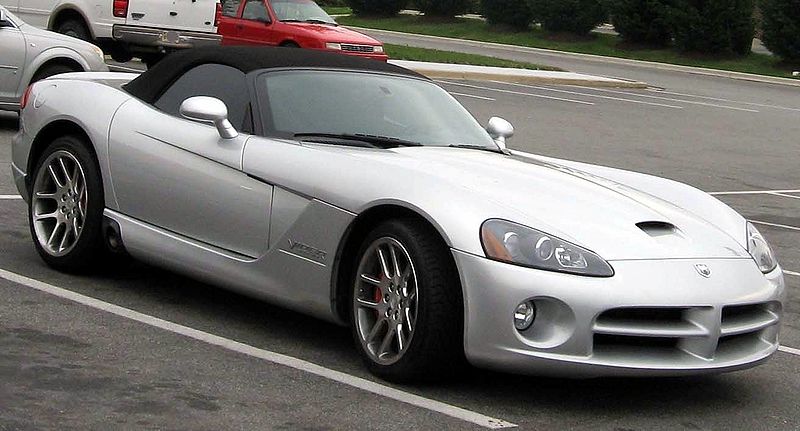
The Dodge Viper underwent a major redesign in 2003, courtesy of DaimlerChrysler's Street and Racing Technology group. The new Viper SRT-10 was heavily restyled with sharp, angled bodywork. The engine was enlarged to 8.3 L (505 cid/8,285 cc)[2] which, with other upgrades, combined to increased output to 500 hp (370 kW) (373 kW) and 525 lb·ft (712 N·m) of torque. The chassis was also improved. It became more rigid and weighed approximately 80 pounds less than the previous model. An even lighter and stronger chassis was planned, but was abandoned because of cost. It is unlikely that the cost increase would have reduced the car's performance value, as it was already one of the fastest cars under $300,000. Parts from the planned suspension were used in the Hennessey Viper Venom 1000 Twin Turbo, however. The initial model was a convertible. In 2004, Dodge introduced a limited edition Mamba package. Mamba edition cars featured black interiors, with red stitching and trim and saw their MSRP price rise by roughly $3000. 200 Mambas were produced.The new Viper SRT-10 Coupe was introduced in 2005, at the Detroit Auto Show, as a 2006 model. It shares many of its body panels with the convertible but takes its side and rear styling cues from the Competition Coupe. The new coupe looks much like the previous Viper GTS and retains the "double-bubble" roof shape of the original, along with the original GTS's taillights as well offering the original Viper Blue paint scheme with white stripes (referred to as GTS Blue) for an added homage to the original Viper coupe. The engine was also certified by the SAE to produce 510 hp (380 kW) and 535 lb·ft (725 N·m) of torque. It is important to note that the engine makes the same power as before, only the numerical value of the power was changed. Unlike the original coupe, the chassis was not modified. This made the new coupe heavier than the convertible, and thus slightly slower in low speed acceleration. Handling and high speed performance were improved by the coupe's stiffer frame, reduced drag, and increased downforce.No 2007 model Vipers were produced. Instead, Chrysler chose to give the 2006 model an extended run while preparing the updated 2008 model.

Dodge Viper Second generation SR (1996–2002)

A coupe model called the GTS was also introduced in 1996. Dubbed "dubble bubble", the roof featured slightly raised sections above each seat to accommodate usage of helmets, a throwback to its intended purpose. Indeed, the Viper's performance has made the vehicle popular for both amateur and professional racers. Vipers can be seen participating often in drag racing, road racing and drifting. The GTS, like its predecessor, was chosen as the pace car for the 1996 Indianapolis 500.Technically this was not a 'new' generation, but the same car with minor modifications such as increased engine power, stiffened and lightened chassis, an improved suspension, and reduced braking distances; the 1996 to 2002 Viper GTS had a lighter (approximately 650 lb) 450 bhp (336 kW) engine, which could complete the quarter mile 0.7 seconds faster and increased top speed by 35 km/h (22 mph) or so. The revised suspension, stiffer chassis, and aerodynamic body raised lateral grip to 0.98 g (9.6 m/s²), although other reports show the 1992 model with 1.0 g. Slalom runs could often reach or exceed 70 mph (110 km/h). Brakes once again lacked ABS, and as a result made the Viper appear deficient in braking capability when compared to ABS equipped cars.Along with the updated performance came the inclusion of some of the "luxuries" the car did without before. Dual front airbags were added to the vehicle's safety equipment list in 1997 as mandated by the government. The car was also exported to Europe, where it was rebadged as a Chrysler, and sold under this marque from 1997 to 2003.In the first six years of production almost 10,000 Vipers were sold. Minor evolutionary changes including new 18" diameter wheels were introduced in the 1999 model. Subsequent versions featured light-weight hypereutectic pistons and an improved exhaust system. 1999 saw the introduction of the Cognac Connolly interior package. Continuing the refinements, an ABS system was introduced in 2001. In 2002, the end of second generation production was celebrated with the release of 360 commemorative "Final Edition" models. These models were painted red with white stripes, paying tribute to the famous race-winning Oreca cars.

Dodge Viper First generation SR (1992–1995)

The first prototype was tested in December 1989. It debuted in 1991 with two pre-production models as the pace car for the Indianapolis 500 when Dodge was forced to substitute it in place of the Japanese-built Stealth due to complaints from the UAW, and went on sale in January 1992 as the soft roofed RT/10 Roadster.The centerpiece of the car was its engine. Originally designed for a truck platform and based on the Chrysler LA design, a division of the Chrysler Corporation revamped Dodge's cast-iron block V10 for the Viper by recasting the block and head in aluminum alloy. Some within Chrysler felt the pushrod two-valve design, while adequate for the truck application, was unsuitable for a performance car and suggested a more comprehensive redesign which would have included four valves per cylinder. Chrysler, however, was uncertain about the Viper's production costs and sales potential and so declined to provide the budget for the modification.The engine weighed 711 lb (323 kg) and produced 400 hp (298 kW) at 4600 rpm and 465 ft·lbf (630 N·m) of torque at 3600 rpm, and thanks to the long-gearing allowed by the torquey engine, provided surprising fuel economy at a claimed 21 mpg US (11.2 L/100 km) if driven sedately. The body was a tubularsteel frame with resin transfer molding (RTM) fiberglass panels. Underneath, it was a crude and rude "kit car assembly" similar to what home builders had been building for years with Cobra replicas. Much of the suspension, following the manufacturer's "engine first" mantra, was sourced from the Dodge Dakota pickup. Typical of American performance car design, it had a front-mounted engine driving the rear wheels; it was also very light in comparison to modern Ferraris with a curb weight of 3,280 lb (1,488 kg) and lacked all modern driver aids such as traction control or anti-lock brakes. Car and Driver magazine referred to this generation as "the world's biggest Fat Boy Harley", and likened driving it to "playing ping pong with a Louisville Slugger baseball bat." Despite this, in straight line performance, it completed a quarter mile in 12.6 seconds and had a maximum speed of over 180 mph (290 km/h). Its large tires allowed the car to average close to 1 g in corners, which is comparable to modern sports cars. However, the car proved tricky to drive at high speeds. The brakes' lack of ABS resulted in stopping distances longer than that of the Dodge Neon.The car was also devoid of any luxuries at all. Along with the absence of exterior door handles, the vehicle lacked windows and even a roof. Although a soft top cover was available, it was designed primarily for outdoor vehicle storage. In terms of interior space, the trunk was large enough for the rain cover and little else. Chrysler's purpose for the vehicle was clear in almost every aspect of its construction; from the unyielding bolstering of the seats to the side-exit exhaust that came with its own disclaimer against passenger injury. Performance came first, creature comforts last (if at all).

Viper Competition Coupe

As of 2003, a special, non-street legal Viper SRT-10 Competition Coupe is available from Dodge for race car drivers, picking up where the GTS-R racing variant left off. The power and torque ratings have been improved, along with the vehicle being stripped of anything not essential for racing, such as the interior body panels, carpet, instrumentation, air conditioning, and stereo systems which lightened the car by 380 lb (170 kg). The Competition Coupe comes equipped with a full roll cage, a racing fuel cell, and other racing-related equipment. It is not sold through dealers and is purchased from Dodge directly as, essentially,a very expensive race car component. Pricing is approximately US$139,000. The Viper Competition Coupe sees action in the highly competitive SCCA Speed GT World Challenge.In 2004 Samuel Hubinette used a Competition Coupe with a modified rear axle for the Formula D, in which he won the title before the car was barred by the end of theseason (due to the fact FD would adopt D1 Grand Prix regulations from the following year which had already prohibited the car from competing) and was replaced by an SRT-10 the following season.After a few one-off entries in the Spa 24 Hours, from 2006, the Viper Competition Coupe raced in Europe fulltime for the first time, joining the new FIA GT3 European Championship with the Italian team Racing Box. At the end of the year,Oreca announced the development of a package transforming the car to GT2 regulations in national championships.


Specifications:

price: $100 000 USD
engine: V10
position: Longitudinal Front Engine
valvetrain: OHV 2 Valves / Cyl
displacement: 8275 cc / 505.0 cu in
bore: 102.36 mm / 4.03 in
stroke: 100.6 mm / 3.96 in
compression: 9.6:1
power: 387.8 kw / 520.0 bhp @ 5600 rpm
hp per litre: 62.84 bhp per litre
torque: 732.14 nm / 540.0 ft lbs @ 4600 rpm
redline: 6100
drive wheels: RWD
body / frame: Composite Body Panels
front brakes: 18.0
rear brakes: Brembro Vented Discs w/ABS, Power Assist & 4 Piston Calipers
front wheels: Front 45.7 x 27.9 cm / 18.0 x 11.0 in
rear wheels: Rear 48.3 x 35.6 cm / 19.0 x 14.0 in
front tire size: P305/35ZR18
rear tire size: P345/30ZR19
steering: Rack & Pinion w/Power Assist
front suspension: Independant Unequal Upper & Lower A-Arms w/2.25in Race Springs,
rear suspension: Independant Unequal Upper & Lower A-Arms w/2.25in Race Springs,
weight: 1361 kg / 3000 lbs
wheelbase: 2510 mm / 98.8 in
front track: 1565 mm / 61.6 in
rear track: 1641 mm / 64.6 in
length: 4676 mm / 184.1 in
width: 1961 mm / 77.2 in
height: 1186 mm / 46.7 in
transmission: Tremec T-56 6-Speed Manual
gear ratios: 2.66:1, 1.78:1, 1.30:1, 1.00:1, 0.74:1, 0.50:1
final drive: 3.07:1
top speed:n.a.
0 - 60 mph: 3.8 seconds
0 - 100 mph: 9.2 seconds
0 - 1/4 mile: 11.8 seconds
drag: .40 Cd
epa city/hwy: 520.0